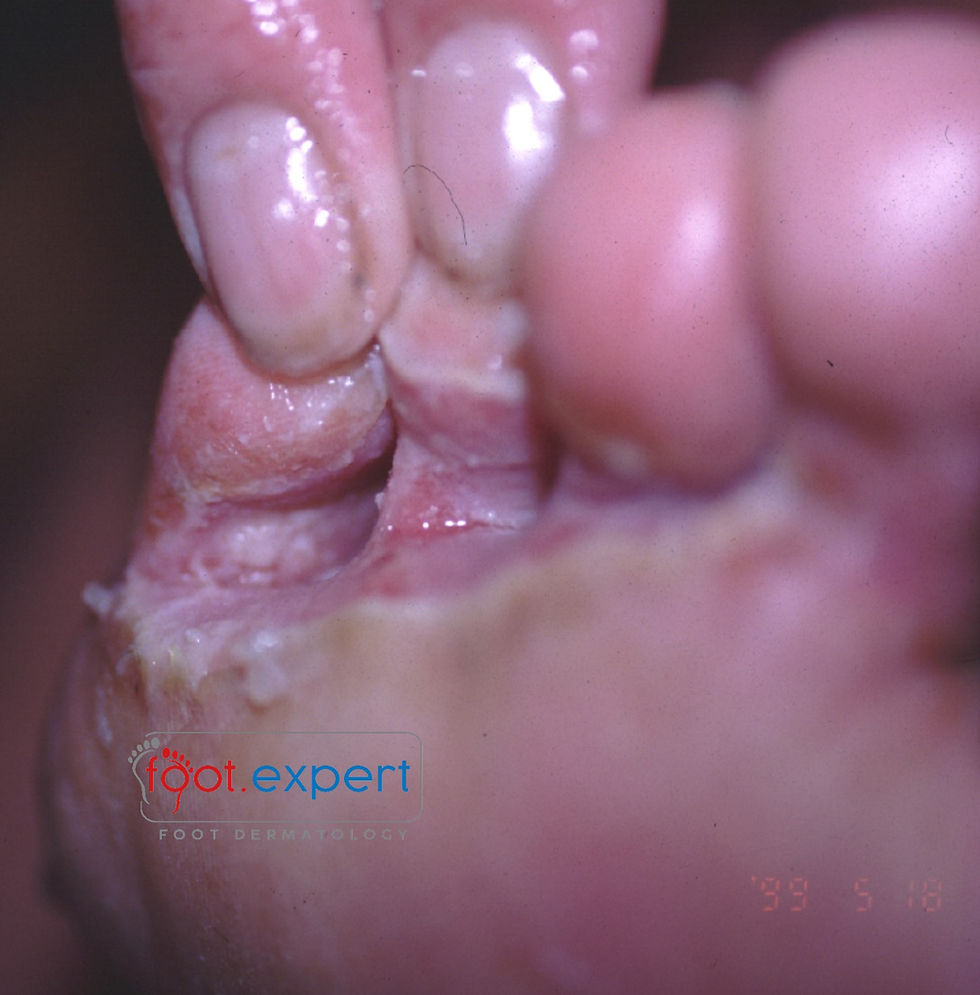
Terbinafine or Azole topically – which is better for tinea pedis?

Tinea pedis, caused by dermatophyte fungi, is a very common clinical infection in podiatry. For most treatment is very straightforward as there are over the counter and pharmacy topical creams and preparations to treat the infection. Podiatrists in many countries may prescribe, sell or recommend many of these simple treatments but what do we know about them in terms of performance? Is there difference between one product and another?
In this blog, I will delve into the published evidence to elucidate any differences between them which may help to guide clinicians’ decision making.

History of common topical antifungals
The imidazole derivatives have been commonplace in the treatment of tinea pedis and other superficial fungal infections caused by dermatophytes for many years. In 1958, chlormidazole was first discovered to have antifungal properties in humans but it wasn’t until 1969, miconazole was first discovered and reported [1]. This rapidly led to the introduction of this (as Daktarin®) and other topical azoles such as clotrimazole (Canesten®) and econazole (Pevaryl®) as topical treatments for fungal skin infections [2].
Terbinafine is a much newer agent discovered in 1983, as a derivative of naftifine [3], coming to market globally and in the UK in 1991 [4] following clinical studies and approval. It was originally marketed by Sandoz, which later became Novartis, under the brand name Lamisil® - familiar to podiatrists as a topical treatment for athlete’s foot (still today marketed by Karo Pharma).
The imidazoles and terbinafine have topically largely superseded older preparations of the time like Whitfield’s ointment (a benzoic and salicylic acid containing preparation) and tolnaftate - a topical thionocarbamate discovered in 1962 [5] which had long application times and lower clearance rates.
Terbinafine versus Azoles in dermatophytosis
As a new drug topical drug launched in the UK around 1991, much of the research published compared terbinafine to placebo and to the existing azoles on the market. So, what did this research show?
I refer to two systematic reviews, both published in 2007 which investigated topical treatment of tinea pedis [6, 7]. First, reassuringly, from the evidence available that azoles and terbinafine are more efficacious than placebo treatments. Azoles and terbinafine when used for dermatophyte infection of the foot could reduce treatment failure by around 67-70% compared to a placebo, or to put another way - they work very well.
Putting azoles and terbinafine head-to-head, a theme emerges. The analysis showed when researchers directly compared allylamines (terbinafine) against azoles across 11 different clinical trials for tinea pedis, allylamines came out ahead [6]. Specifically, the numbers show that using an allylamine gives you about a 37% lower risk of treatment failure compared to using an azole.
Is there more to it? There are other things that need to be considered and early studies on terbinafine do give some insights in differences between the two classes of drugs.
Terbinafine is absorbed rapidly
Studies of the pharmacokinetics of terbinafine shows that topical terbinafine rapidly concentrates within the epidermis when applied, peaking in just 4 hours [8]. Repeated daily applications in this study showed that terbinafine levels in the epidermis only increased by 15%, meaning it is rapidly absorbed and concentrated within the skin.
Terbinafine is faster to reach a cure
One consistent finding in studies is that topical terbinafine versus azoles is much faster to reach a mycological cure. An early study showed that after one week’s application, 51% of patients were mycologically clear of infection in just one week rising to 88% at the end of the study [9]. This has been a consistent finding in many comparative studies and confirmed in a meta-analysis [6].
In a study comparing clotrimazole and terbinafine, one week of topical terbinafine provided an optimal response - equivalent to four weeks of clotrimazole. However, one week of clotrimazole resulted in a significantly lower response than 4 week of clotrimazole [10]. Essentially, azoles require a standard 4 weeks of applications to reach optimum cure, whereas terbinafine can reach this in just one week.
The main difference between terbinafine and azoles that is often quoted “terbinafine is fungicidal and azoles are fungistatic”. That must be qualified – that statement relates particularly to dermatophytes, remembering that they are just a subset of fungi but are responsible for the vast majority of tinea pedis.
Yeasts and non-dermatophyte moulds are rarer causes but for some yeast infections (i.e. Candida albicans) terbinafine is fungistatic not fungicidal in action [11]. In a rare case like this, an azole would have an advantage because of its anti-yeast activity.
Terbinafine treated tinea is slower to relapse
Another finding from the Bergstresser study [10] was difference in relapse rates. Of the patients on one week of topical terbinafine, less than 10% relapsed within 11 weeks of treatment. However, of patient completing 4 weeks of clotrimazole, 28% relapsed within 8 weeks after infection.
Frequency of Application
Terbinafine topically is recommended to be applied once or twice a day (Lamisil® Patient Information Leaflet UK). In practice, personally I find a proper once daily application is sufficient to clear infection. The patient leaflet for Canesten® Athletes foot cream (Clotrimazole 1%) suggests 2-3 times daily.
Cost of Product
Both terbinafine and clotrimazole (and other azoles) in the UK are available as generic and various branded products. At an average price 15g, at the time of writing, clotrimazole maybe around £4-£5, Miconazole £5 - £6 with terbinafine around £6-£7 for a 15g tube. It may suggest azoles are cheaper but taking into account the dosing / frequency of application terbinafine as a once daily application will be considerably cheaper for a course of treatment - technically a patient will use double or treble the amount of an azole compared to terbinafine and a cure may take up to four weeks, whereas terbinafine will achieve this is a much shorter time.
So, which is best?
If you have read through this far, you will be thinking that topical terbinafine is the first choice to prescribe, supply or recommend to patients. For tinea pedis, it works faster, is more effective with lower relapse rate and overall is a cheaper buy. On top of that, a faster cure may mean better patient compliance. In general, I would have to agree but there are one or two considerations.
Firstly, I make the point that in some instances the azole maybe a preferred choice. As I have previously discussed (click here), azoles have an additional property that terbinafine doesn’t. Earlier research has shown that azoles demonstrate additional antibacterial activity in the lab [13, 14]. Work has demonstrated activity against gram positives like Staphylococcus aureus (including MRSA), Corynebacterium and Enterococcus. From a podiatrists point of view, interdigital erythrasma could be a potential candidate along with mixed bacterial and fungal interdigital infections (see my earlier blog). I should conclude by saying that this antibacterial function is NOT an approved indication so using the product in this way would be an off-label use.
Finally, the issue of resistance. Currently a complicated picture globally with case reports of terbinafine and azole resistance but at this stage, this should not preclude the use of any antifungal for tinea pedis for most patients. I will cover this in a forthcoming blog, but please read my earlier post on this topic.
To conclude, both topical azoles and terbinafine preparations are able to treat dermatophyte skin infection effectively in most cases when used as directed on the patient information leaflet. Differences do exist between them and practitioners should consider these with patients based on their individual circumstances and clinical needs.
References
1. Godefroi, E.F., et al., Preparation and antimycotic properties of derivatives of 1-phenethylimidazole. Journal of Medicinal Chemistry, 1969. 12(5): p. 784–791.
2. Teixeira, M.M., et al., New Antifungal Agents with Azole Moieties. Pharmaceuticals, 2022. 15(11): p. 1427.
3. Newland, J.G. and S.M. Abdel-Rahman, Update on terbinafine with a focus on dermatophytoses. Clin Cosmet Investig Dermatol, 2009. 2: p. 49–63.
4. McKay, D.A., O.M. Schofield, and E.C. Benton, Terbinafine-induced subacute cutaneous lupus erythematosus. Acta Derm Venereol, 2004. 84(6): p. 472–4.
5. Hashimoto, Y., et al., Toxicologic and pharmacologic properties of tolnaftate, an antitrichophyton agent. Toxicology and Applied Pharmacology, 1966. 8(3): p. 380–385.
6. Crawford, F. and S. Hollis, Topical treatments for fungal infections of the skin and nails of the foot. Cochrane Database Syst Rev, 2007. 2007(3): p. Cd001434.
7. Korting, H.C., et al., Comparable Efficacy and Safety of Various Topical Formulations of Terbinafine in Tinea Pedis Irrespective of the Treatment Regimen. American Journal of Clinical Dermatology, 2007. 8(6): p. 357–364.
8. Hill, S., et al., An investigation of the pharmokinetics of topical terbinafine (Lamisil) 1% cream. British Journal of Dermatology, 1992. 127: p. 396–400.
9. Berman, B., et al., Efficacy of a 1-week, twice-daily regimen of terbinafine 1% cream in the treatment of interdigital tinea pedis. Results of placebo-controlled, double-blind, multicenter trials. J Am Acad Dermatol, 1992. 26(6): p. 956–60.
10. Bergstresser, P.R., et al., Topical terbinafine and clotrimazole in interdigital tinea pedis: a multicenter comparison of cure and relapse rates with 1- and 4-week treatment regimens. J Am Acad Dermatol, 1993. 28(4): p. 648–51.
11. Petranyi, G., J.G. Meingassner, and H. Mieth, Antifungal activity of the allylamine derivative terbinafine in vitro. Antimicrob Agents Chemother, 1987. 31(9): p. 1365–8.
12. Brugmans, J.P., J.M. van Cutsem, and D.C. Thienpont, Treatment of Long-Term Tinea Pedis With Miconazole: Double-Blind Clinical Evaluation. Archives of Dermatology, 1970. 102(4): p. 428–432.
13. Schaller, K., In vitro antibacterial activity of different clotrimazole formulations. Chemotherapy, 1982. 28 Suppl 1: p. 32–6.
14. Nenoff, P., et al., New insights on the antibacterial efficacy of miconazole in vitro. Mycoses, 2017. 60(8): p. 552–557.