
Why do feet itch?

Itch (pruritus) is a common symptom, often frustrating for the patient - making life difficult as they may be unable to sleep, relax or work. In some cases, itch can be debilitating as a painful condition. In this blog, I will look at a range of conditions that may present as itching primarily of the feet.
What is Itch?
Put simply, it’s an unpleasant sensation of the skin that creates an urge to scratch. It has evolved as a protective mechanism from external agents. Itching is a very common symptom in dermatology and often drives a sufferer to seek a diagnosis and treatment. It can arise from a primary pruritic dermatosis or be present with no dermatological manifestation at all. Traditionally, itch is classified as acute (if lasting for less than 6 weeks) or chronic if it has been present for longer.

Traditionally, it was thought to be physiologically similar to pain, sharing similar neurological pathways, varying just in intensity but recent research strongly suggests it has its own mechanism and process often initiated by a range of immune, chemical, mechanical or cellular processes in the skin and then conveyed along specific neuronal pathways [1].
The majority of itch sensations occur due to activation of sensory nerve endings which are stimulated by a single, or combination of, chemicals known as “pruritogens” (See table 1 ) [2]. In addition, damage to the sensory nerves themselves may also lead to the generation of an itch (neuropathic itch) - in diabetes, for example.

Table 1: Pruritogens and their receptors (after Hashimoto & Okuno [2]). Reproduced under the creative common licence.
Assessing Itch on the foot
Itching can be widespread (generalised) or localised, but it is a symptom, not a diagnosis and so if it presents it is important to begin to look for potential causes. Table 2 below lists the most common causes. As always, a thorough history (including a timetable of events, known triggers, exacerbating and alleviating factors) with a thorough examination of the skin to uncover any underlying dermatoses is essential.

Table 2 : Common causes of itch
Depending on the assessment, a full blood count can often be useful if no obvious cause can be found, as this includes checks on iron levels, liver function and thyroid function. When malignancy is suspected additional imaging may also be required.
.
Skin Conditions
In practice, dermatoses of the skin on the feet are the main cause of itching through various mechanisms. Consequently, the cause of the itch is more obvious when present with a skin condition.
For some patients with tinea pedis, if present, itch is a symptom which drives them to seek treatment [3]. Anecdotally, it has been observed that itch is more often associated in tinea pedis from zoophilic species of dermatophytes. The reasons are not fully understood but a recent paper highlighted that Microsporum canis, a dermatophyte infection acquired from cats and dogs produces a fungal protein (micasin) which has been shown to induce an itch response [4].
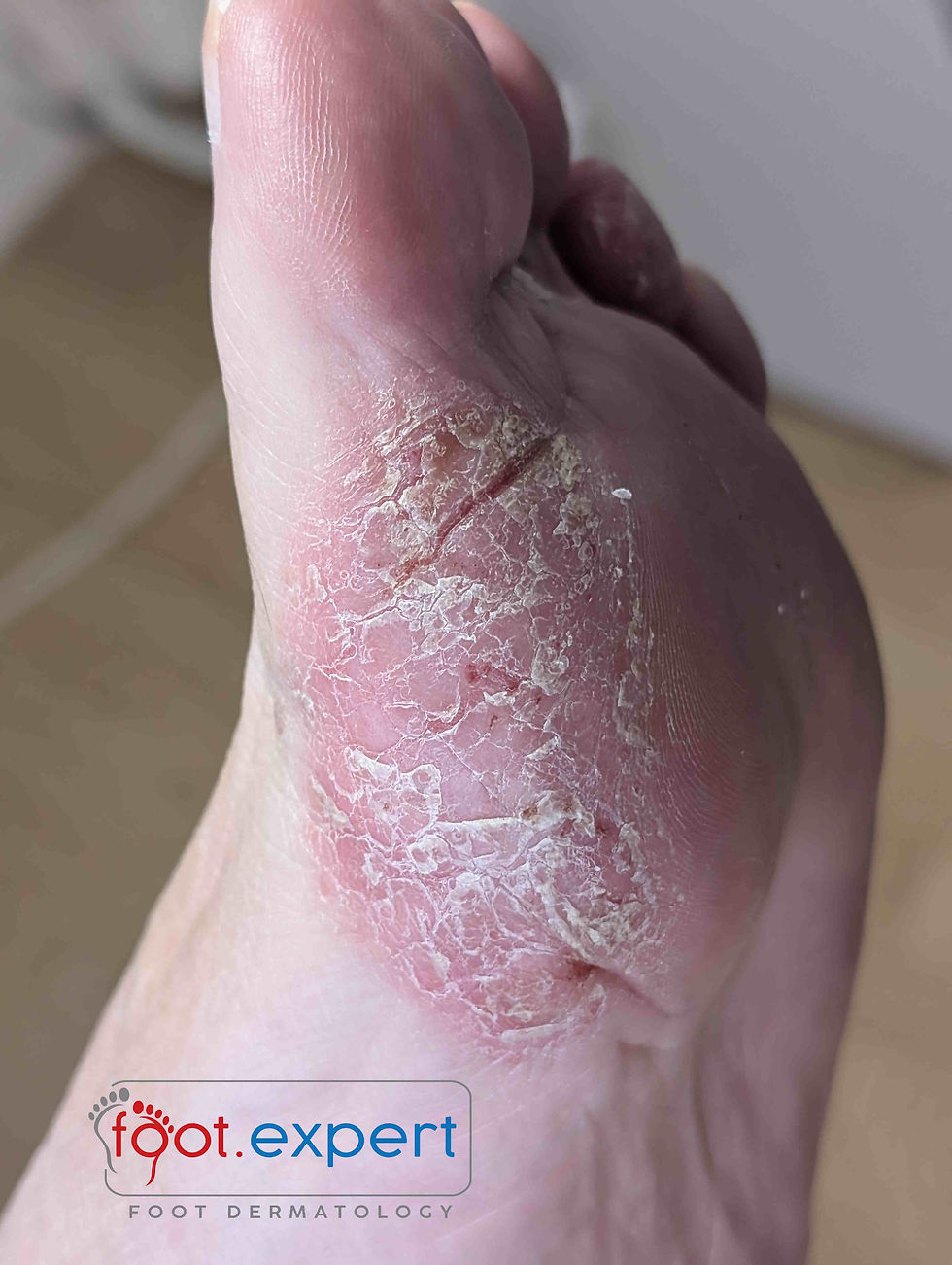
Psoriasis and eczema are well known to present with varying levels of itch between individuals. In psoriasis and eczema, several chemical mediators are suspected including cytokines, and peptides [5, 6].
Infestation with scabies (read my earlier blog) can lead to intense itching of the feet, particularly at night when the skin is warm. Science has yet to explain exactly the cause, but it may be a combination of an innate immune response of the complement pathway to components of the mite itself. Direct activation of Toll like receptors on nerve endings and adaptive immune responses to mite faeces have also been investigated [7]. The itch of scabies has been observed to frequently extend long after the infection has been cleared.
Liver disease and itch
Liver disease is a frequently cited cause of itch - localised or more widespread forms but often without any rash. Hepatic itch is commonly seen with cholestatic disorders (disruption to the flow of bile) – there are a range of conditions which can affect the liver and the bile ducts (read more here). Typically, cholestatic itch is reported with a diurnal variation, usually worse in the evening or night time and frequently located to the soles, palms and limbs [8].
To date, several pruritogens have been implicated – bile acids, substance P and lysophosphatidic acid but there is no clear answer [8]. Clinically, itch is usually the only symptom but cholestatic disease may occasionally be accompanied by jaundice, tiredness and fat-soluble vitamin deficiencies (A,D, E and K) with their own accompanying symptoms [9].
Foot Itch during pregnancy

Itching of feet during pregnancy can occur for various reasons. One cause is Cholestasis of Pregnancy which is characterised by a palmar-plantar pruritus, which may also occur on other parts of the skin. Usually later in the pregnancy a disruption in the flow of bile acid leads to a rise in blood levels with a subsequent itch and possible jaundice. Patients should be immediately referred for detailed blood analysis and diagnosis when suspected [10].
Malignancy
Chronic itch can be a sign of malignancy – frequently with lymphoma and leukaemia but it has been associated with solid tumours [11]. Typically, it presents without skin lesions although secondary lesions develop as a results of the itch scratch cycle. In addition, certain types of pruritic dermatoses can in themselves herald internal malignancies often long before any other symptoms arise. A recent case demonstrated extreme foot and leg pruritus in a 14 year old girl found to have an underlying lymphoma [12]. The full case can be read here.
Drug induced pruritus
Itching is a well-recognised feature of adverse drug reactions and surprisingly, many common medications can induce itching. A large retrospective database study at one institution of over 1 million patients identified over 9800 patients developing pruritus within 3 months of commencing a new medication [13]. Patients in this group were more likely to be female and in the age group 50-79 years old. Pruritus affected around 1% of patients - the drugs most likely to cause itch are listed in table 2 below:

Table 2: Causes of medication related itch in a survey of patients [13]
How do you manage itching of the feet?
Management of itching depends very much on the cause. Where there are treatable causes, itching may reduce once treatment is underway – such as an antifungal agent for athletes’ foot or topical preparation for psoriasis. Typical anti-inflammatory agents and immune modifying drugs used in dermatological diseases include topical steroids, methotrexate, ciclosporin, calcineurin inhibitors, JAK inhibitors, phototherapy and biologics. Where the cause is elsewhere, management of underlying issues such as liver disease or malignancy can reverse the symptoms of pruritus. Neuropathic itch may require the use of drugs such as opioids, antidepressants and GABA type drugs.
Implications for podiatrists
Itchy feet require a careful assessment to elucidate the underlying cause. For the vast majority of podiatry patients, the cause is likely to be localised and dermatological and therefore requires a formal diagnosis. Typical causes such as athletes’ foot can easily be managed. Another common but sometimes overlooked cause is xerosis – particularly in older patients. Dry skin can be a cause of itch and management with emollients and skin care advice can be effective for most patients. Similar where inflammatory skin conditions like psoriasis and eczema exists, emollients are the mainstay. Wet wrapping for more severe cases can be helpful as described here. Alternatively, calcipotriol (Vitamin D3 derivatives and short course topical steroids can be effective).
When the itch is unaccompanied with any dermatological disease then careful assessment is required, being mindful of the typical causes listed in table 2. Iron deficiency anaemia is very common often accompanied by itching, affecting nearly 1 in 3 patients globally and around 3% of UK men and 8% of UK women [NICE 2025]. Being mindful of other related symptoms such as tiredness, headaches, restless legs and dry skin which may point towards this diagnosis. Where necessary full blood screening may be required or referring patients back to their GP for further investigations.
References
1. Guo, C.J., N.S. Grabinski, and Q. Liu, Peripheral Mechanisms of Itch. Journal of Investigative Dermatology, 2021.
2. Hashimoto, T. and S. Okuno, Practical guide for the diagnosis and treatment of localized and generalized cutaneous pruritus (chronic itch with no underlying pruritic dermatosis). The Journal of Dermatology, 2025. 52(2): p. 204–220.
3. Ogasawara, Y., Prevalence and patients consciousness of tinea pedis and onychomycosis. Nippon Hifuka Gakkai Zasshi, 2003. 44(4): p. 253–260.
4. Yang, H., et al., The Fungal Secretory Peptide Micasin Induces Itch by Activating MRGPRX1/C11/A1 on Peripheral Neurons. Journal of Investigative Dermatology, 2024.
5. Komiya, E., et al., Molecular and Cellular Mechanisms of Itch in Psoriasis. Int J Mol Sci, 2020. 21(21).
6. Hong, J., et al., Management of itch in atopic dermatitis. Semin Cutan Med Surg, 2011. 30(2): p. 71–86.
7. Ständer, S. and S. Ständer, Itch in Scabies—What Do We Know? Frontiers in Medicine, 2021. Volume 8 - 2021.
8. Hegade, V.S., S.F. Kendrick, and D.E. Jones, Drug treatment of pruritus in liver diseases. Clin Med (Lond), 2015. 15(4): p. 351–7.
9. Bergasa, N., Pruritus of Cholestasis, in Itch: Mechanisms and Treatment, E. Carstens and T. Akiyama, Editors. 2024, CRC Press/Taylor Francis: Boca Raton.
10. Abdul Waheed, M.I., et al., Navigating Perinatal Challenges: A Comprehensive Review of Cholestasis of Pregnancy and Its Impact on Maternal and Fetal Health. Cureus, 2024. 16(4): p. e58699.
11. Yosipovitch, G., Chronic pruritus: a paraneoplastic sign. Dermatol Ther, 2010. 23(6): p. 590–6.
12. Swansson, W., et al., An undifferentiated itch in a girl aged 14 years. Australian Journal of General Practice, 2026. 55: p. 383–386.
13. Huang, A.H., et al., Pruritus Associated with Commonly Prescribed Medications in a Tertiary Care Center. Medicines (Basel), 2019. 6(3).


